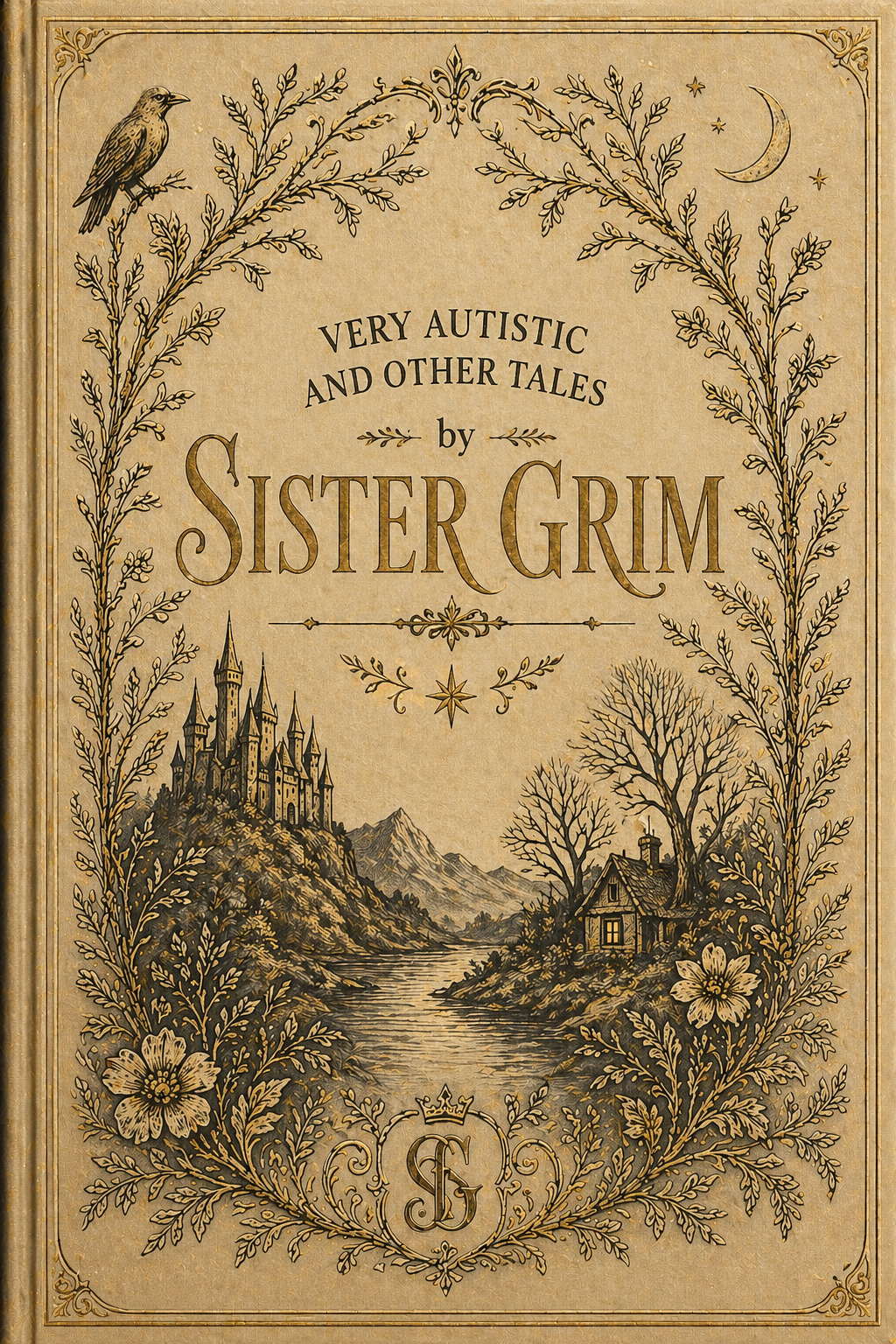
The Fairy Tale Version
Not every horror story starts with a villain. Some start with a pioneer.
The Brothers Grimm collected their stories from the same German-speaking world that later produced the clinical frameworks we still argue about today. In the originals, children got abandoned in forests, eaten, disposed of by the people supposed to protect them. Then the stories got sanitised. The horror edited out. Made palatable for children.
The same thing happened to the history of autism.
The person who actually got there first was Grunya Efimovna Sukhareva — a Jewish psychiatrist from Kyiv who published the first clinical description of autism in 1925. Six boys. Social withdrawal, restricted interests, sensory sensitivities — children who today some would mislabel as high functioning, or not real autism. These are the children the field was built on. In 2015, Manouilenko and Bejerot compared her original descriptions point-by-point with the DSM-5. Every major criterion matched.
Sukhareva's boys and girls would today be told they are not real autistics by the same people defending a history that erased the woman who documented them.
In 1927 she published a follow-up describing five girls — greater emotional dysregulation, subtler motor differences, stronger social camouflage. Where the boys were called "talking machines," the girls were labelled difficult. Eccentric. The field didn't just erase the girls. It erased what she had already proven: that the presentation changes by sex, that camouflage is not neurotypicality, that "difficult" is a label applied to a child whose needs were never met. Sukhareva saw them in 1927. The field spent nearly a century pretending they were invisible. What happened to the girls who couldn't mask — the ones who didn't pass for eccentric — is a different and darker chapter of the same story.
She was not alone in seeing clearly. Georg Frankl and Anni Weiss, two Jewish doctors working in Vienna in the early 1930s, described the same traits a decade before Kanner and Asperger. Frankl later went to work for Kanner. The work survived. The names didn't.
She didn't sort. She documented. She built schools. She followed children over years with the goal of keeping them connected to real life. She left no mechanism for deciding who was worth saving.
Then Hans Asperger came along, claimed novelty, and the field named itself after him. Sukhareva's 1926 German-language paper had appeared in one of the only psychiatry journals in existence — one Asperger demonstrably cited for other work. Lorna Wing told historian Adam Feinstein that Asperger may have read it. Sula Wolff, who produced the first English translation of Sukhareva's work in 1996, noted that his literature review was incomplete and that he failed to mention the account of six cases exactly like his own. Whether he read her work and chose not to cite it, or could not credit a Jewish academic under the regime he was operating within, the omission was consequential.
His record is contested but documented. Czech (2018) and Sheffer (2018) established that Asperger referred disabled children to Am Spiegelgrund, a Vienna clinic inside the Nazi child euthanasia programme where nearly 800 children died. One documented case is Herta Schreiber — a child Asperger described in writing as an "unbearable burden to her mother" and "incurable," knowing the clinic was a collection point for child murder. Tatzer et al. argued in 2022 that there was no evidence he knew the true purpose. Czech rebutted directly: Viennese citizens were protesting institutional mortality rates months before the referrals, Asperger was a member of virulently antisemitic organisations by 1940, and he was signing diagnoses with Heil Hitler by 1938. He told the parents it was for the best. He framed it as care.
Sukhareva survived. Her work didn't — not in the West, not for decades. Language barriers, Cold War divisions, and Soviet institutional pressures all played a role. But those conditions existed for other researchers who made it into the canon. The hierarchy decides what the barriers are allowed to stop.
Asperger was one node in a much larger machine. Aktion T4 documented 70,273 deaths in its centralised gassing phase. Historians estimate 275,000 to 300,000 total deaths across all phases — the German Federal Archives and the Memorial for the Victims of the Nazi Euthanasia Murders both cite figures in that range, the variance reflecting deliberate secrecy and record destruction as Allied forces closed in. The language throughout was compassionate. Mercy. Relief from suffering. The framing of useless eaters — lives that consume without contributing — did not disappear in 1945. It migrated into parliamentary debates, policy documents, comment sections. The uniform changed. The argument did not.
Some will argue this was economics — that scarcity made the calculation inevitable. But scholarship on Indigenous disability frameworks, including Diné (Navajo) teachings documented by Sandra Yellowhorse and Māori frameworks studied by Jill Bevan-Brown, describes disability as relational responsibility embedded in community care, not burden to be calculated. Canadian scholarship identifies the economic burden framing as a colonial construct that displaced existing community support systems. This was not a universal human response to scarcity. It was an ideological choice, made by specific people, in service of a specific hierarchy.
This programme did not emerge from hatred alone. It emerged from a hierarchy that had decided certain lives were worth less — and then built a clinical and legal architecture to make that decision feel rational, even kind.
It was also the blueprint. Not metaphorically — literally. The SS officers who ran Aktion T4 — Wirth, Stangl, Eberl — were transferred to lead Operation Reinhard in 1942. Stangl became commandant of Sobibor and then Treblinka. The personnel transfer is documented fact. What transferred with them — the justificatory framework, the language of mercy, the sorting of lives by worth — is the argument the post-war record keeps making for itself.
Disability killing wasn't a footnote to the Holocaust. It was the rehearsal, the blueprint, the personnel pipeline, and the operating logic.
That architecture didn't disappear. It got rebranded. It shows up in eligibility criteria, budget decisions, every system that measures a disabled life against the cost of supporting it. The language of mercy is still in use. So is the paperwork.
Same argument. Different letterhead.
When disabled people and parents organised — cross-disability, coalition-based, Nothing About Us Without Us — they won. Institutions closed. Rights were legislated. The framework that still underpins disability law was built together, across different diagnoses, different support needs, different levels of access. That coalition was the threat. The response was to fracture it. Resource scarcity is the mechanism: desperate people fight over what's available, the fight gets framed as ideology when it's actually exhaustion and bankruptcy up against each other. Neither group created the scarcity. Both are being managed by it. And while the fight plays out, disabled people who don't fit either camp rot in the community — deposited into rooming houses, into isolation, into poverty, and told this is what liberation looks like.
For decades before any of this, the children who would today be recognised as autistic with high support needs were not called autistic at all. They were labelled feeble-minded, mentally defective, childhood schizophrenic. They were lost — not missed, lost — deposited into institutions that operated on the same logic as the wards that fed T4. The autism label was kept clean, rare, and manageable by sorting them somewhere else entirely.
It was Lorna Wing — working in the 1980s, and citing Sukhareva's research — who first argued that social impairment existed across all levels of intellectual ability. That the "talking machines" and the non-verbal children in the institutions were part of the same spectrum. That the division was administrative, not biological. This was not welcomed. It complicated the hierarchy. It meant the sorting had been wrong all along.
When the DSM finally collapsed the categories in 2013 — merging Asperger's, Pervasive Developmental Disorder, and Autistic Disorder into one Autism Spectrum Disorder — it was framed as a victory for science. But the bread was not increased. By folding everyone into one category without increasing resources, the system guaranteed a rationing war. It handed critics the weapon they needed: look at the self-advocating, verbal autistic and ask, "but what about the really affected ones?" — using the very inclusion that was supposed to recognise everyone, to silence the people who could speak back.
The data on what actually happened is documented. Between 1990 and 2010, as autism diagnoses rose across the United States and Canada, diagnoses for intellectual disability fell in nearly equal measure. This is diagnostic substitution. We did not create more autistic people. We stopped calling them subnormal. The children who were "lost" were found — reclassified into a framework that finally had room for them. The hierarchy called this "diagnostic inflation." The more accurate term is overdue correction.
The DSM does not divide autistic people by suffering. Support levels are administrative snapshots — averages used to route resources, not fixed descriptions of a person, not rankings of whose life has more value. They get conscripted into that work anyway.
Which is how we arrive at the comment sections, the hearings, the clinical settings — anywhere an autistic person speaks and someone responds: but what about the really affected ones? The same pattern that erased Sukhareva is still running. Anyone with enough social credit can centre themselves in our history, can speak about our experience with more institutional authority than we're granted about our own lives. Autistic people remain the last people consulted about autistic experience. It sounds like concern. It functions as a sorting mechanism. It has a very long history of being delivered with kindness.
Centring means the people most affected by a decision have the most weight in making it. Not consultation. Not representation. Not a seat at a table designed by someone else. It is the difference between research done on a community and research done with one. It is best practice in every field that has learned from its mistakes — medicine, law, education.
And here is what the history shows: the sorting was never reliable. Diagnostic criteria shifted for a century. Girls were invisible to the framework until Sukhareva's work was finally read, decades after her death. The tools were never validated. The assessments were never neutral. Race, gender, class, geography — all of it shapes who gets diagnosed and who gets believed. If the hierarchy couldn't sort reliably then, it cannot sort reliably now.
The children written off as intellectually disabled or feeble-minded were written off with tools that couldn't reliably measure them. A landmark 2007 study found autistic children scored on average 30 percentile points higher on non-verbal reasoning tests than on standard IQ scales — a third labelled low functioning scored in the average range when tested differently. The DSM-5 itself acknowledges IQ scores in autism are unstable, particularly in early childhood. We do not know how many children were institutionalised, written off, presumed incompetent on the basis of a number that was measuring the wrong thing. Sorting people with unreliable tools and calling the consequences inevitable is not science. It is institutional violence.
The sorting continues now, in different paperwork. Black and Indigenous children are still significantly more likely to be diagnosed with conduct disorder than with autism — receiving a label that routes them toward punishment rather than support. A 2007 study found African-American children were 2.6 times less likely than white children to receive an autism diagnosis on their first specialty visit, and twice as likely to receive a conduct disorder diagnosis instead. The hierarchy did not stop sorting when the DSM changed. It found new categories. It always does.
The argument that the spectrum has become too inclusive is a historical hallucination. We are not expanding the borders. We are reclaiming territory that was stolen. The talking machines of 1925 were never an extra category — they were the first category. The girls who camouflaged their way through 1927 were not a modern fad — they were documented before the first Nazi referral was ever signed. The children labelled feeble-minded and lost were always part of the same spectrum — the field just refused to see it until Lorna Wing named it. When people claim the diagnosis has lost its meaning, what they mean is that it has lost its containment. They liked it better when we were a tragedy to be managed rather than a community that remembers its own history. And if the hierarchy cannot sort reliably, it has no authority to declare some of us better off dead.
Every fairy tale has a promise at the centre. This one promises relief — an end to suffering, a peaceful door for those the story has decided cannot be saved. We are not against the door. We are against a world that builds only the door and calls it compassion. If the promise is genuine, it has to apply to all of it: the poverty, the isolation, the withheld diagnosis, the support that never came. You cannot claim to be against suffering while defending the inequity that produces it.
Every generation has had its own Sukharevas — professionals who did the real work alongside us. We have always known who they are. Some of you reading this are them. You are either standing on the shoulders of those who came before us, or you are repeating the erasure and calling it progress.
Autism is not a monopoly. Diagnosed before six is not a monolith — it is a spectrum. Every time we sort and fail to centre disabled voices equitably within our own community, we hand the mechanism back to the people who built it. Her work didn't disappear. The men and women who insist they are the matter experts — not the people they study and sort — keep trying to erase her.
Germany attempted restoration. The documentation was preserved. The reckoning was real enough that it became one of the strongest international allies in the framework of Never Again.
And yet the same forces are re-emerging — on the far right in familiar form, and on the progressive left in language that sounds like compassion. Eugenics has never needed a uniform. It has only ever needed a hierarchy willing to decide whose suffering counts, whose life costs too much, whose death can be framed as relief.
Never Again was not meant to be a slogan. It was meant to be a standard we hold every time the hierarchy tries to make itself feel natural again — whatever it is wearing.
For some of us, the nightmare has not ended.
We are still holding it.
Sources
- Manouilenko I, Bejerot S. "Sukhareva — Prior to Asperger and Kanner." Nordic Journal of Psychiatry, 2015. DOI: 10.3109/08039488.2015.1005022
- Sher D, Gibson J. "Pioneering, prodigious and perspicacious: Grunya Efimovna Sukhareva's life and contribution to conceptualising autism and schizophrenia." European Child & Adolescent Psychiatry, 2023. DOI: 10.1007/s00787-021-01875-7
- Ssucharewa GE, Wolff S. "The first account of the syndrome Asperger described?" European Child & Adolescent Psychiatry, 1996. DOI: 10.1007/BF00571671
- Czech H. "Hans Asperger, National Socialism, and 'Race Hygiene' in Nazi-era Vienna." Molecular Autism, 2018. DOI: 10.1186/s13229-018-0208-6
- Sheffer E. Asperger's Children: The Origins of Autism in Nazi Vienna. W.W. Norton, 2018.
- US Holocaust Memorial Museum. "Euthanasia Program and Aktion T4." encyclopedia.ushmm.org
- US Holocaust Memorial Museum. "Operation Reinhard." encyclopedia.ushmm.org
- Memorial for the Victims of the Nazi Euthanasia Murders / Gedenkstätte Pirna-Sonnenstein. stiftung-denkmal.de
- Tatzer E, Maleczek W, Waldhauser F. "An assessment of what Hans Asperger knew about child euthanasia in Vienna during the Nazi occupation." Acta Paediatrica, 2022. DOI: 10.1111/apa.16319
- Czech H. Response to Tatzer et al. Acta Paediatrica, 2023. DOI: 10.1111/apa.16730
- Dawson M, Soulières I, Gernsbacher MA, Mottron L. "The Level and Nature of Autistic Intelligence." Psychological Science, 2007. DOI: 10.1111/j.1467-9280.2007.01992.x
- American Psychiatric Association. Diagnostic and Statistical Manual of Mental Disorders, 5th ed. 2013.
- King MD, Bearman PS. "Diagnostic change and the increased prevalence of autism." International Journal of Epidemiology, 2009. DOI: 10.1093/ije/dyp261
- Mandell DS, Ittenbach RF, Levy SE, Pinto-Martin JA. "Disparities in diagnoses received prior to a diagnosis of autism spectrum disorder." Journal of Autism and Developmental Disorders, 2007. DOI: 10.1007/s10803-006-0314-8
- Yellowhorse S. "Indigeneity and Disability: The Teachings of our Ancestors and Being in Relation Towards Harmonious Outcomes." Disability Visibility Project, 2023. disabilityvisibilityproject.com
- Bevan-Brown J. "Including people with disabilities: An indigenous perspective." 2013. DOI: 10.1007/978-1-4614-1034-2
- Patton L. "Disability as a Colonial Construct: The Missing Discourse of Culture in Conceptualizations of Disabled Indigenous Children." Canadian Journal of Disability Studies, 2022. DOI: 10.15353/cjds.v11i2.645